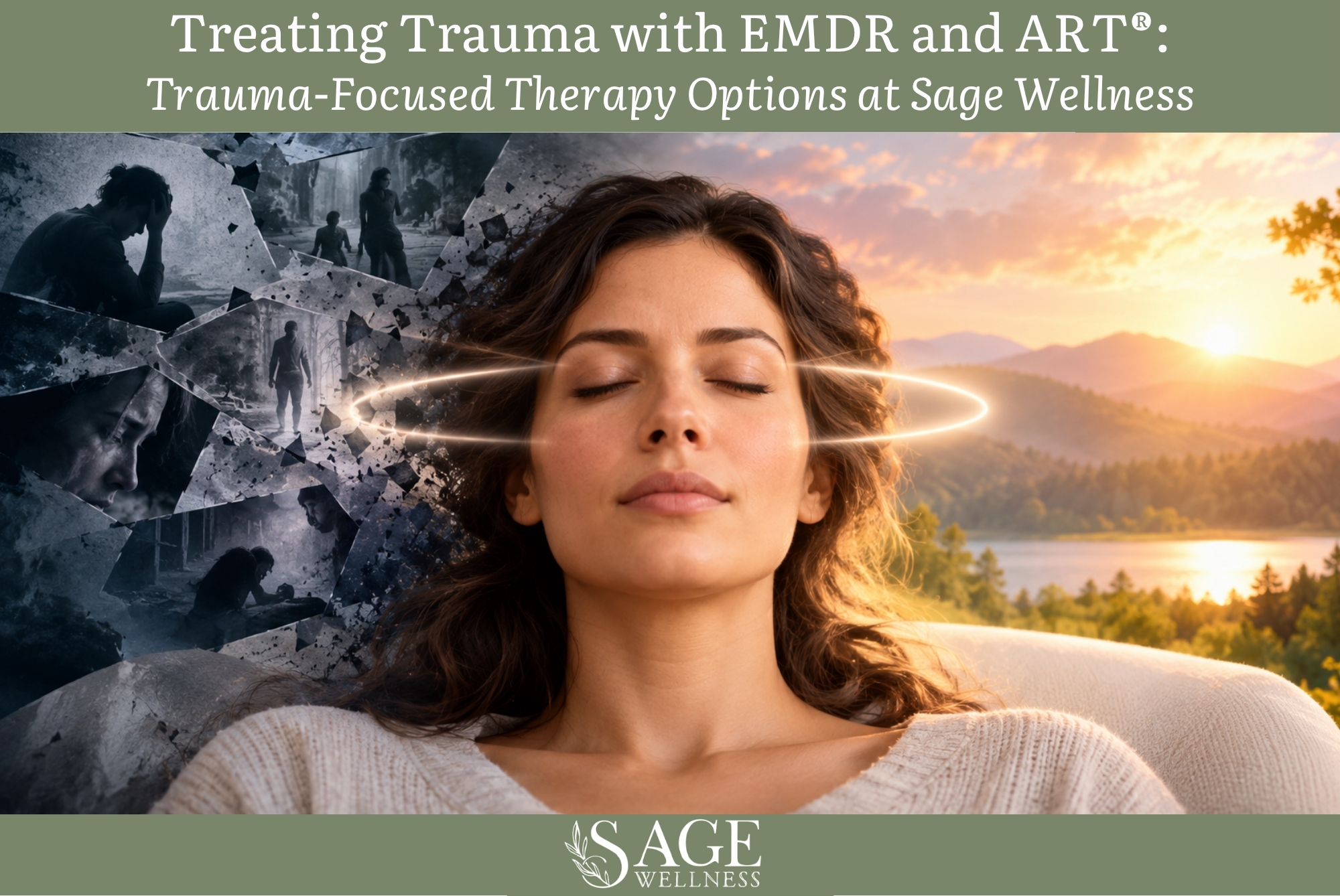
Trauma doesn’t always look like a single dramatic event. It can be a car accident, a difficult childhood, a medical crisis, an assault, or years of chronic stress that leave the nervous system stuck in survival mode. Whatever its source, trauma has a way of embedding itself in the body, not just the mind — which is part of why talking about it isn’t always enough to heal it. Two of the most effective approaches we use at Sage Wellness are EMDR and ART.
What Is Trauma, Really?
Trauma is what happens when an experience overwhelms your ability to cope, leaving the nervous system unable to fully process and file it away. Instead of becoming a memory that feels finished, the experience stays “live” — showing up as flashbacks, nightmares, physical tension, emotional flooding, or a persistent sense of danger, even long after the original threat has passed.
What Is EMDR?
EMDR stands for Eye Movement Desensitization and Reprocessing. It’s an evidence-based therapy that uses guided bilateral stimulation — typically side-to-side eye movements, tapping, or sounds — while you briefly focus on a distressing memory. This process appears to help the brain reprocess the memory so it’s stored the way ordinary memories are: as something that happened in the past, rather than something that still feels like it’s happening now.
EMDR is one of the most researched trauma treatments available and is recognized by organizations including the World Health Organization and the American Psychological Association as an effective treatment for PTSD.
What Is ART?
ART, or Accelerated Resolution Therapy, is a newer, related approach that also uses eye movements, but combines them with imagery and voluntary memory replacement techniques. Many clients find ART works more quickly than traditional talk therapy — often in a handful of sessions — and it tends to focus on replacing the distressing images connected to a memory rather than requiring you to describe the traumatic event aloud in detail.
How EMDR and ART Are Similar — and Different
Both approaches share a foundation: they use bilateral stimulation to help the brain reprocess distressing material, and both are structured, time-limited therapies rather than open-ended talk therapy. The main differences are pace and technique — ART tends to move faster and relies more heavily on guided imagery, while EMDR follows a more standardized eight-phase protocol. Your therapist can help you determine which approach — or combination — fits your history and comfort level best.
What a Trauma Therapy Session Looks Like at Sage Wellness
Trauma treatment always begins with safety and stabilization — building coping skills and a trusting relationship with your therapist before any reprocessing work begins. You are never required to share every detail of what happened; both EMDR and ART are designed to work even when you keep the specifics private. Sessions are paced to your nervous system, with regular check-ins so you always feel in control of the process.
Who Can Benefit
EMDR and ART are used to treat PTSD, but their benefits extend well beyond that diagnosis. Clients come to Sage Wellness for trauma treatment related to:
- Car accidents and other single-incident traumas
- Childhood adversity or neglect
- Medical trauma and health crises
- Assault, abuse, or violence
- Grief and traumatic loss
- Phobias, panic, and performance anxiety
- First-responder and workplace-related trauma
Frequently Asked Questions
Does EMDR really work?
Yes. EMDR is supported by decades of clinical research and is recognized by major health organizations, including the World Health Organization and the American Psychological Association, as an effective, evidence-based treatment for PTSD and other trauma-related conditions.
How many sessions of EMDR or ART are typically needed?
It depends on the complexity of the trauma. Single-incident traumas may resolve in as few as three to six sessions, especially with ART, while trauma from repeated or long-term experiences generally takes longer. Your therapist will give you a clearer estimate after your initial assessment.
Will I have to talk in detail about my trauma?
No. Both EMDR and ART are designed to work without requiring you to narrate the traumatic event in detail. You stay in control of how much you share, and your therapist will pace the work around your comfort and readiness.
Is EMDR only for PTSD?
While EMDR was originally developed for PTSD, it’s now used to treat a wide range of concerns, including anxiety, panic disorder, phobias, grief, and the lingering effects of difficult childhood experiences.
Ready to talk to someone?
Sage Wellness offers confidential individual, couples, family, and group therapy at our 8th Ave and Haile Village offices in Gainesville, FL, as well as secure telehealth across the state. Call or text (352) 474-8882, or request an appointment online, to be matched with the therapist who’s the right fit for you.
Contact Information
Sage Wellness
📍 4881 NW 8th Ave, Suite 1, Gainesville, FL 32605
📍 4850 SW 91st Terr, #P102, Gainesville, FL 32608
📞 Phone: (352) 474-8882
🌐 Website: gainesvillesage.com
Contact Sage Wellness in Gainesville, FL to learn more about trauma therapy, EMDR, ART®, and individualized mental health counseling.